
I was back in Las Vegas for Autodesk University 2026. The space felt right again. You are indoors more in Vegas, and I missed Nashville’s outdoor time and seeing the sky. Connecting in person still wins. I caught up with friends, connected with ten different customers, and yes, the LEGO giveaways were a highlight.
Autodesk said about a third of the attendees were new. That tracks with the week I had. Plenty of familiar faces, and plenty of people seeing AU for the first time.
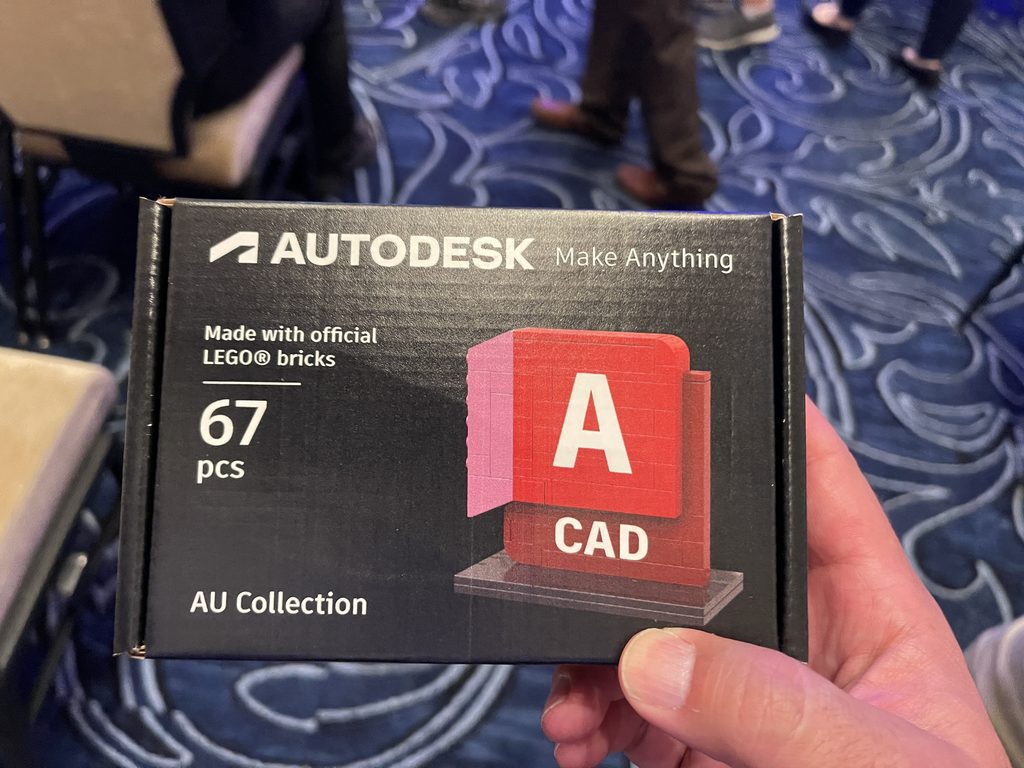
Highlights – AutoCAD Lego Logo + the incomparable Buddy Legnon. If I forgot to get a picture with anyone, it’s because we were having such a wild time, not because I forget to take pictures (obviously).

We’ll cover:
- What changed in the AI showcases
- What plant design customers kept asking for
- Where industrial piping still sits
- Why early AI adoption still matters
- One fabrication highlight worth watching
- What Autodesk keeps getting right in AutoCAD
What Changed in the AI Showcases
Everyone is curious about AI. That part is not new. What I did not see as much of is practical, hands-on workflows that teams are already solving in the open. Some of that may be intentional. People play things close to the vest when a capability is still taking shape.
The Autodesk showcases told a different story than last year. Last year could feel like the AI buzzword. This year I saw practical demonstrations of actual workflows and engineering processes that will improve how work gets done. That was exciting.
In the hallways, people were still curious and short on shared playbooks, and the real process demos are what made the show floor feel different this year.
What Plant Design Customers Kept Asking For
Plant design folks are still very interested in automating pipe supports. That ask has not gone away. It shows up every time the conversation turns to hours that disappear into repetitive detailing.
A second theme came from multiple customers: AutoPlant migrations. Several people want to move off AutoPlant. Some are still running AutoPlant on AutoCAD 2022 because it is not supported on newer AutoCAD versions, and that support gap is pushing them to move.
At Piping Labs we do Plant 3D work and AutoPlant migrations, so those conversations landed close to home.
Where Industrial Piping Still Sits
There was more focus on data and AI, and more focus on the field and operations side. Those two are coming together. That is the right direction for the industry.
There is still not much from the industrial piping point of view. That remains my key focus, and it was the quiet part of an otherwise loud show. If you live in plant design and industrial piping, you will find adjacent energy in AI, data, and field workflows. You will still have to translate a lot of it into your own world.
Why Early AI Adoption Still Matters
There is still a lot of value in being early to adopt AI for engineering processes. Part of that is figuring out the right thing to solve. Adopting AI in your daily work is a differentiator right now. The constant theme remains doing more with fewer people.
The old way was to build software with strictly defined workflows. With AI, workflows can be fuzzier and you still knock out a good bit of the work. You reach 80 percent complete faster. It will not give you a finished system, but it gets you further, sooner, while you decide what deserves a hard process.
I am working toward that. If you wait for a perfect playbook, early adopters will pull ahead on cycle time while you are still defining the workflow.
One Fabrication Highlight Worth Watching
Stratus (by GTP) showed a Plant 3D integration in very early beta: a way to go straight from the model to production for fabrication. That path is not common, and it is really important.
Early beta means it is not a finished story. The direction is the news: Plant 3D content moving toward fabrication without a second authoring world in between.
What Autodesk Keeps Getting Right in AutoCAD
New AutoCAD features are always exciting. Over several years Autodesk has done a strong job improving 3D models and visualization. The attention to detail in how people actually work shows up in small places.
As an expert user, I appreciate tools that get easier without forcing me to learn a new workflow from scratch. The best improvements feel natural. You reach for them the way you already work, and the friction drops.
Closing
AU 2026 was a great week overall. I reconnected with friends, had useful customer conversations, and saw Autodesk demos that were clearer than last year’s AI buzz. The same asks kept coming up around pipe supports and AutoPlant migrations, and Stratus showed a rare path from Plant 3D to fabrication that is worth watching.
I missed the outdoor rhythm of Nashville. I did not miss the value of being in the room. The differentiator right now is putting AI into your daily engineering work, accepting fuzzier paths that still get you to 80 percent faster, and choosing the right problems while you learn.